Showing posts with label Classics. Show all posts

Thursday, 18 December 2014

Alice's Adventures in Wonderland by Lewis Carroll

Alice's Adventures in Wonderland
One of the classics of children's literature, Alice's Adventures in Wonderland is world-famous and has inspired a culture all of it's own. It's a fixture in the childhood of many Western children, myself included. 

I've read a fair few books this year that I enjoyed the film versions of as a child, but if I learnt one thing it is that the book is always different. At least I thought so until I read this book. Disney's animated version seems to sum it all up if I am perfectly honest. There are a few minor changes and additions to the story, but ultimately if you watch the film you really have read the book. 

Focusing just on the book itself, the pace felt very slow despite Alice's constantly changing predicament which I think is mostly due to the fact that I didn't understand what was going on. Although I can recall most of the plot I still didn't really 'get' it. I've heard before that Alice's Adventures has prose full of adult humour, that could potentially bore children. If this is true then I must have the mentality of a child because I was often bored. 

Carroll's nonsense poems also proved a sticking point for me as I could not understand what they were for. I like that the book encourages the imagination and demonstrates that sense and logic should not always be thought higher of than creativity. In this respect Carroll's novel is very much responding to it's time when Romanticism was for the most part over and science was beginning it's ascent to the pedestal. That being said, I like logic and the story lacked logic, at least in my opinion.

Another issue that I had was with Alice herself. I found her character to be bad-tempered and pretentious. She seemed to me to be argumentative and a little prissy. Dorothy at the end of her adventure in Oz had made many friends, but Alice really hadn't made any. It was very apparent that as a character she did not belong in that world and maybe that's also true for me. 

As a classic I can appreciate its merit and understand why it has stood the test of time. However, much like Peter Pan this just wasn't for me. Perhaps this is a children's book I really should have read as a child. However, I am glad that I read it and completed my goal of reading five children's books that had fantastical worlds and can now give away my copy for someone else to read.

Rating: ★★

Sunday, 21 September 2014

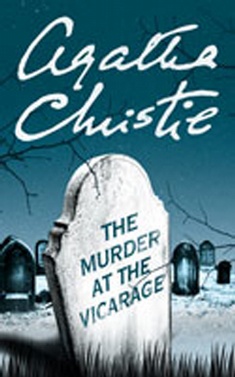
Murder at the Vicarage by Agatha Christie | Miss Marple #1

This was my first Agatha Christie novel and the first to feature her infamous Miss Marple. The title is incredibly shelf-explanatory and the plot centres around the murder of Colonel Pletheroe who is killed one afternoon whilst visiting his friend Reverend Clement ....

Something that I was struck by, and perhaps shouldn't have been considering the title of the books, was that story is narrated by the vicar himself. It made for an interesting perspective as I had expected the story to be told in the third person and so be second guessing everyone, but it was nice to have some certainty in an otherwise very uncertain text.

The plot was typical of Christie and made for some very cosy crime. I almost had the feeling that the book was perpetually trapped on a Sunday afternoon. Miss Marple herself did not play a starring role in the book, but I quite liked that we were getting a view of her from another's perspective. However, I would like to learn more about her and her history and hopefully in later books Christie goes into more depth about her main character.

I have to admit that I did not guess who the murderer(s) were and that was the greatest joy for me in this book as usually on murder mystery TV shows I quite often guess whodunnit early on. I have since watched the ITV adaptation of this book and found it to be incredibly obvious, but then I suppose I already knew and TV cannot allow for as many subtleties as a book. Horror and tragedy have never been my thing, but I think that Agatha Christie is definitely an author that can offer me a crime novel in an entertaining way.

One thing that I like about murder mysteries and Agatha Christie in particular is that you never quite feel that it's real. This may be because the 1930s feels far removed from 2014, but even then the characters seem to be quite hollow and for once in a book that is exactly what is needed. I doubt very much that I would be happy with being entertained by the death of another person, but in this instant it feels as though it is morally sound.


Wednesday, 30 July 2014

The Wonderful Wizard of Oz by L. Frank Baum | Adventures in Oz #1

This is another of those children's books that I never read when I was a child. I suppose I thought that I had because I had watched the film a lot, but it seems that 'somewhere over the rainbow' isn't actually in the book. Though this is a pity as it is a brilliant song, I have to say that next to nothing disappointed me about this book.

The Wonderful Wizard of Oz tells the story of Dorothy and her dog Toto who are caught up in a tornado one day in their home of Kansas and transported to the magical world of Oz. During their landing into Oz the house that they were travelling in accidentally lands on the Wicked Witch of the East and kills her, much to the relief of the inhabitants.

The first thing that I noticed about this novel were the differences in plot from the 1939 film. The witch of the North is in fact quite an old lady, not the glamourpuss of the '39 film and the ruby slippers are silver! After realising both those things I quickly got rid of the picture of Judy Garland in my head and began to picture Dorothy as she was in the book: a child.

This book was actually quite dark for what I had expected of a children's story including several instances of murder and cruelty. There was a giant spider, rabid wolves, killer bees and enslaved flying monkeys! I liked that Baum didn't shiy away from things such as this in his book and fully embraces them. The feeling of genuine danger makes for a quick pace and great atmosphere. As a reader you feel as though that you don't know what is going to happen next which exactly what is needed from a good adventure.

I think the overall moral of the story, that the power is within you to achieve what ever it is that you want, whether it be feeling as though you have brains, a heart etc, is within you at all times was both engaging and uplifting. It was a very empowering message and one that I thought was demonstrated enormously well.

The theme of 'home' is also something that was explored well in this novel. Of course Dorothy wants to get back Kansas, but she isn't the only one looking to get home. It seems that everyone is searching for a place to belong or are looking to reclaim the place that they once called home. The way in which all of Dorothy's party all ended up finding a place of their own was very organic and at times quite subtle so that it isn't until the end that you realise it has all worked out for the best.

This book is where my knowledge of the Land of Oz ends, but knowing that there are 12 canonical texts makes me so happy. Unfortunately I don't have the second story in my possession nor does my local library have it so I'm bumping that one up to the top of my wish list.

Rating: 

Next in series: The Marvellous Land of Oz


Thursday, 24 July 2014

Sense and Sensibility by Jane Austen | Lost in Austen

Sense and Sensibility was the first of Jane Austen's novels to be published and follows the Dashwood sisters, Elinor and Marinne, after the death of their father. As is characteristic of Austen's novels, the girls are mediocre when it comes to upper class society and impoverished thanks to the lack of genorosity of their half-brother and his wife. Necessity sees them relocated from their childhood home to a cottage on the grounds of a wealthy relation of their mother's. From this point on there are a series of events that see the sisters drifiting on the outer edges of engagements before finally ending up happily married and financially comfortable.

One of the biggest problems I had with this novel was the character of Marianne. I found her transformation from spoiled, silly childishness to stoic maturity hard to accept. Of course this book is set in a different time and teenagehood didn't exist, but is a broken heart really a cure for being vapid? I felt her decision to marry Colonel Brandon at the end of the novel was unrealistic even within the context of the plot. I understand that Austen wanted to tie up all the lose ends in order to make for a happy ending, but I think that even if Marianne  and Brandon had met and courted others and married them I would have found it more believable. Their story is hardly what I would call a romance. 

Elinor too frustrated me, but for different reasons. I found her self-sacrificing nature not to be the heroism that I assume Austen intended, but instead weakness of character. For all the faults with Marianne, her character is still passionate. That is of course because Marianne is the sensibility to Elinor's sense, a dichotomy that did very little for me. As the narrative is told mostly from the perspective of Elinor, as readers, we are privy to most of Elinor's thoughts and feelings. As a sister, daughter and friend she cannot be faulted in her ability to please others but in her role as a lover she fails miserably. Even through the veil of Regency honour and propriety Austen makes the connection between Edward Ferrars and Elinor very clear and I am disappointed that Elinor never so much as confides in her mother or sister. However, this romance is one that I believed and one that I found myself rooting for throughout the novel. If the novel had focused upon this couple I would have been perfectly satisfied with it. 

The redemption of Willoughby was something that I also felt dubious about. Even having finished the novel I am not sure that Willoughby is given redemption, but I do feel as though at least at the very end Austen attempts to induce sympathy for him. Willoughby for all intents and purposes is a 19th century gold digger, but is also a victim of a society that tells him that money dictates his worth as a human being (as are all the others). This is an example of the overall impression that I got from the novel, namely as a platform for Austen to attack the same idle classes and their shallow snobbishness that she herself belonged to. How can the rich and idle criticise the rich and idle? Certainly not in any way that I could take seriously.

Sadly my reading of this novel was coloured by many things that the book did just not overcome. It was coloured by my outrage at Austen's hypocrisy, my idea of what a romance is or should be and high expectations of a 'Jane Austen novel'. I was entirely underwhelmed and am happy to take at least some responsibility for that. Thankfully, my experience of this novel has not put me off Austen or any re-imaginings of Sense and Sensibility.

Rating: 

Monday, 28 April 2014

World Book Night 2014

As any book connoisseur will know it was World Book Night last Wednesday and as part of a personal challenge to implement ten traditions in the next 12 months, my partner and I started what we hope will be our annual World Book Night Book Swap.

The aim with the book swap is to share our love of a book that we have read and loved in the past year and get the other person to read it within that month. In the future we are hoping that our choices will be a secret until they are presented on that day, but this year excitement got the better of me and we told each other long before the day.

My choice for him was Aldous Huxley's Brave New World which I read last year for a university module. I bought him Oryx and Crake by Margaret Atwood for his birthday last month and he loved the dystopian genre which really sealed my choice.

His choice for me was the Russian classic The Master and Margarita by Mikhail Bulgakov. The inspiration behind this choice was that he is a great lover of Russian literature and this is one that he has enjoyed most recently. I am very excited to read my first piece of Russian fiction and look forward to reading one of the classics. We will do reviews for both of these books closer to the end of the month when we have both completed them.

Thursday, 6 March 2014

Of Mice and Men by John Steinbeck

This was the first book that I picked out of my TBR jar and one that fit quite nicely as I need to re-familiarise myself with it to help tutor my younger sister with exams. I didn't study this novel when I was in school as I did my English GCSE a year early but many of my friends did, as did another of my sisters and my partner. With so many people reading it around me I read this book when I was 16 and I remembered most of the story, but very little other than that. So this is technically a re-read although I do feel as though I began the book with very little opinion and so am looking at it with fresh eyes.

It is a novella about George and Lennie, two land workers during The Depression who yearn for the American Dream. The 'American Dream' at it's very heart is the dream of freedom and who would dream of it more than those who are shackled most by society? This story is very much a story of the marginalised. It is about Crooks: the black man, Candy: the physically disabled, Curly's wife: the woman and Lennie: the man with learning difficulties. It is a story of how their dreams are sidelined, ignored and crushed for the sake of the privileged. It chronices the victory of the white people, the men, the able, the landowners.

Lennie is childlike and naive but not what we could call innocent. He commits multiple acts of cruelty albeit unwillingly. He kills countless mice, then his puppy and finally Curly's wife. He is rough without meaning to be, but his most redeeming quality is his unshakable faith in George and their dream of a place to call their own. Ultimately, I found myself believing in the little piece of land and the rabbits because Lennie did.


George I find to be incredibly paternal as he took care of Lennie by imposing on him what he believed to be best. George always believed Lennie's 'failure' to be inevitable as we see at the very beginning of the story where George tells Lennie to return to that very spot if there were ever to be trouble. Sadly, George is not quite the hero that Lennie believes him to be. By the time the novella begins George no longer believes in the dream that he continuously sells to his ward and spends his time and money at the local brothel despite making it quite clear that he neither trusts nor likes women. His choice at the end of the book to kill Lennie is as much about granting himself freedom as it is about saving his friend. 

I was very disappointed by the treatment of women in this novella. The most we ever hear any woman outside of the brothel is Curly's wife. It says an awful lot about the status of women that the only female character apart from Aunt Clara isn't even given a name, but is defined purely by the man that she is married to. The ranch workers are very quick to label her a 'tart' and trouble, but in actual fact I just think that she is lonely. In her talk with Lennie she explicitly says that she doesn't like her husband and it's clear that men have tried to take advantage of her in the past. She met a man once who claims that he could make her a star in Hollywood. This naivety is something that her and Lennie share and so the conversation that they have before it all goes wrong is one of the sweetest, most touching parts in all the book. 

I was finishing the book just as the sun was setting and it was the most perfectly evocative scene as George asked Lennie to look out across the river and imagine his rabbits. The end of the book is sad and left me feeling a little empty. Afterwards I felt angry with George and the society in which he and Lennie lived. The book as a whole reminded me of the sentiments in Mary Shelley's Frankenstein.  Lennie was the creature, strange and different who is resented for that. Outcast by society which exacerbates what it sees as his 'faults'. Lennie is only different and only suffers because society has 'normal' and rules surrounding it. Society is therefore Dr Frankenstein. It is the creator which ultimately seeks to destroy what it has made because it is frightened by it's creation. Lennie is never as radicalised as the Creature nor George (acting on behalf of and as society) as merciless as Victor Frankenstein but, for me there are certainly strong thematic parallels. 

Ultimately, I could never say that I 'liked' this book. I found it frustrating and was disappointed by it's lack of judgement. I found Steinbeck to be portraying something rather than commenting on it and I just wanted him be less neutral. I know that this is not other's experience of this book but I wasn't that impressed by it and as a result doubt that I will be picking up more Steinbeck in the near future. 

Rating: 


Tuesday, 4 February 2014

When To Stop Reading Part II

When it comes to books, is ok good enough? A while I go posted about when to stop reading a book that you were not enjoying. After ploughing through for a few reading sessions and genuinely giving it all I had, I decided to put the book down and move on . I thought that I had the 'when to stop reading' dilemma sorted, but in the last week it has reared it's ugly head again.

In order to commemorate Charles Dickens' Day which takes place on 7th February every year I decided that I would begin reading more of his work and where better to start than at the beginning? With the help of the internet I discovered that Dickens first novel was The Pickwick Papers and so headed to my local library and checked out the brick of a book. I eagerly started reading and found that it was definitely old fashioned, clearly satirical and had a certain kind of human. I thought that this would be enough to sustain my interest and yet here we are with Dickens' Day having past and I'm still not even a hundred pages through. From my previous post you might think that it would be an easy decision for me to simply stop reading and move onto something else. However, the issue with this book feels different to the disinterest that I felt with Amy and Roger's Epic Detour
The Pickwick Papers is a perfectly fine book to read when I'm actually reading. When I am literally engaged in reading it I am entertained, if somewhat passively. The problem lies when I put the book down. The thing about a good novel is surely that you long to get back to it. In the past when I am fully engrossed in a story I found myself not even caring about train delays, reasoning that this gives me more time to read. So I have a new question: When it comes to books, is ok good enough? 

After a few days thought my conclusion has to be no. I examined my reason for choosing this particular book and realised that I wasn't reading it for the right reasons. I was never really interested in this book in the way that I should have been from the beginning anyway. I didn't even read the blurb before deciding to read it. I chose to read this book purely based on the fact that it was the first of Charles Dickens' books. This can surely never be a good reason to read a book. Isn't this why we resented being told what to read in school? Maybe a different Dickens novel would keep my interest better or maybe Dickens just isn't my sort of thing at all and I think I have to learn to be ok with that. I have goals for my reading this year, but I think the danger is of them becoming quotas and that just isn't going to be fun. So, yes I do want to reach the goals I set myself in January but I have resolved to do it reading whatever it is that I am genuinely interested in reading. 

Saturday, 18 January 2014

Happy Winnie the Pooh Day 2014!

Today is the birthday of Winnie the Pooh author A.A Milne. This means that every year this day is celebrated as Winnie the Pooh Day and this year I decided to jump on the band wagon! A.A. Milne, who was born in 1882, based his stories about Pooh on his son's stuffed animals and even incorporated Christopher Robin into the stories by making him a key character. I was very surprised to learn that Milne studied Maths at Cambridge. I suppose this just goes to show that mathematicians do have imagination! 

Winnie the Pooh was first published on 14th October 1926 so is definitely a children's classic. Last week I read and completed Milne's first Pooh book Winnie the Pooh and next I will be starting House at Pooh Corner. This is a series that I never picked up when I was younger and one that I regret not having read until now because they really do deserve to be as popular as they are.

One of the things that I noticed when reading the book is that it makes no attempt to hide the fact that it is a father making up stories about his son's toys. I liked that it was that honest. I liked that the narrator could be heard when you were reading. I also liked that every so often Christopher Robin would interject and ask questions of the story which made it so much more interactive. This form also helped to make the stories feel intimate and personal. Even though I was often reading them on a busy train, I felt as though I was sitting in front of a warm fire with tea and biscuits. 

I was very shocked to realise that Tigger is not in the first book! When I was growing up it was always Pooh and Tigger and I never really looked too much at characters like Owl and Rabbit. I also don't think that I appreciated how reasonable Eeyore's gloominess is. In all of the stories from the first book I see Eeyore as having genuine reasons for being sad and the poor thing seems to be a victim of some genuine misfortune. In chapter four Eeyore loses his tail which is a part of him! At the beginning of chapter six he is sad because no one has remembered his birthday and in chapter eight his offer of help is completely ignored. I found myself feeling very sorry for Eeyore a lot of the time and I know that he probably doesn't get any happier, but I really whish he would! Maybe in the final book everyone's favourite donkey can have a happy ending. 


I borrowed my copy of this book from the library and I have to to say that it is incredibly beautiful. All of the pictures that are in this post are photographs that I took of the illustrations which were drawn by Ernest H. Shepard. They are simple and evocative and childlike in the best sense of that word. The book had a heart-warming quality that meant even though the stories were simple they brought a smile to your face and the illustrations were a perfect compliment to that. I look forward to the next installment of Pooh and will buying my nieces and nephews a copy of these as soon as they are able to read!

Rating: 


Monday, 6 January 2014

Goal Update

This term in my class our theme is 'Other Worlds' and because of this the children’s tables have all been named with different fantasy lands. We have Hogwarts, Narnia, The Land of Oz, Neverland and Alice’s Wonderland. Explaining to the children that these worlds didn't just pop up in Disney films, but actually originated in books has really got me thinking. 

In light of this I would like to add a new goal to my list this year and that is to read at least one book in which these worlds exist.  What this basically means is that this year I want to read the following books:


-          Harry Potter and the Philosopher’s Stone
-          The Magician’s Nephew
-          The Wonderful Wizard of Oz
-          Peter Pan
-          Alice's Adventures in Wonderland


Having started working in a Primary School in September, I have realised that there are so many great children’s books that I just didn’t read. Even books by my favourite childhood author Enid Blyton. I’m glad that it isn’t now too late to catch up on all of those fabulous stories and over the next few years I hope to make my way through the best of children’s literature. That’s really the only problem with books though isn’t it? There are always so many more to read!

Thursday, 12 December 2013

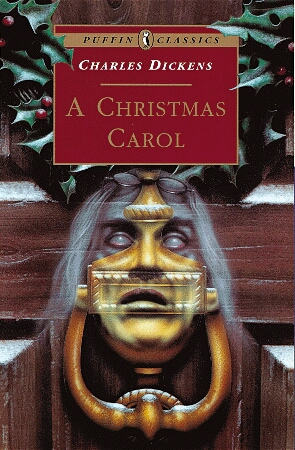
A Christmas Carol by Charles Dickens

A Christmas Carol is the first of the City Year book club reads and was a very seasonal choice. The story follows the spiritual transformation of the protagonist Ebeneezer Scrooge on Christmas Eve as he is visited by four ghosts. The story is one that has remained popular for over a century and if you live in the West the likelihood is that you've seen some kind of retelling whether that be Muppets, Disney or even Blackadder-style. 

The novel itself was very short and moved along at a moderate pace. When we first meet Scrooge it is difficult to believe that he will have any redeeming features as he works Bob Cratchit to the bone, sits hoarding his treasure like a fat dragon and I have to admit that by the end of the book I'm not sure that I was filled with the joy of Christmas cheer. Here is probably a good point to stop and insert a disclaimer that I don't myself celebrate Christmas and haven't done so for the past four years. 
For me, Scrooge is Dickens' representation of the bourgeoisie, a greedy Capitalist who gives up love and laughter in order to be rich. Scrooge is preoccupied with thoughts of little more than profit. He refuses to put more coal on the fire for fear of what it will cost and even lives a relatively Spartan existence himself, although nothing close to the poverty of those he would have locked up in prisons and workhouses. 

The book did, however, work as a ghost story. The Ghost of Christmas Past is for me the most frightening of all the ghosts. The description of him alone is enough to frighten children. He is an amalgamation of Scrooge at every stage of his life. The ghost vacillates between the beauty of youth and the ugliness of old age.What we find comforting about age is that it is a progression. It suggests that we have time, that we have cause and occasion to develop each laugh line, to use all of our muscles in the pursuit of adventure, to wear out our sight and hearing having listened to incredible music and witnessed stunning views. To be confronted with a condensed version of yourself, in the way that Scrooge is, emphasises how short a time you have to do all of those things. It also works to present a distorted reflection of Scrooge's self and begins the systematic breaking down of his character's identity. Furthermore, it is what the ghost represents that must be the most frightening, after all the thing about the past is that it has happened and there is nothing that anyone can do to change it.

Overall, I enjoyed reading the novel as it was the source of a story that seems embedded in my culture. I found nothing redeemable in the character of Scrooge and thought his transformation happened too quickly. Having said that, the novel worked for me as a ghost story and it's themes helped to reinforce my abstaining from Christmas. This is the only Charles Dickens novel that I have ever read, but I would definitely read more in the future.

Rating: